Escape from Alcatraz changes starting procedures for this year’s race. The swim start for this race seems chaotic—athletes jump from the San Francisco Belle into San Francisco Bay en masse, and the entire ship is emptied in less than eight minutes. From what I’ve read, last year’s start was more rushed and disorganized than in previous years, which led to an athlete being paralyzed after someone landed directly on his head during the swim start. Needless to say, I’ve been fairly anxious about this since I signed up for this year’s race, so it’s encouraging to hear that the organizers are making changes to this year’s start procedure. According to this year’s athlete guide, there will be three start locations on the ship instead of the usual two, which should space people out more, and race staff will signal athletes to jump only when the landing area is clear. Hopefully these changes are enough to make the start safer for everyone.
Given to Tri
News
News about triathlon and endurance sports—rule changes, race announcements, and industry updates.
-
-
Ironman updates their competition rules for 2026. This year’s rules formalize the 20-meter bike draft rules for pros, which they announced last month, and clarify how they will work when age groupers interact with pros. They also lessen the penalty for having an unzipped trisuit from disqualification to a warning and a time penalty if not remedied, ban video recording during races (so leave those Meta Oakley glasses home), and rename the Physically Challenged and Intellectual Disability Open Division to Para Open Division, plus a handful of minor wording changes. They’ve also published a summary of the changes and an FAQ.
Nothing too earth-shaking, but I’m surprised that after last year’s confusing changes to the hydration rules, which were only communicated by World Triathlon through a “rule interpretation” document and which Ironman said would only be enforced for pros with “ample notice” given before they took effect for age groups, none of those rules made it into either the 2026 Ironman or World Triathlon rule books, except for the one that limits attachments to the top tube of the bike to a maximum height of 10 cm. I’m assuming this means the rest of the rules in the “rule interpretation” document are still not in effect for age groups, but it would be nice to get some clarification from Ironman one way or the other.
-
No more Mortal Hydration in Ironman aid stations in 2026. From Ironman, via email:
Ahead of your race next year, we wanted to introduce you to Precision Fuel & Hydration, our Official Hydration Partner for the 2026 IRONMAN and IRONMAN 70.3 Global Series, including the 2026 IRONMAN World Championship in Kona, Hawai’i and the 2026 IRONMAN 70.3 World Championship in Nice, France.
Trusted by reigning IRONMAN World Champion Solveig Løvseth and 2x IRONMAN 70.3 Champion Jelle Geens, Precision Fuel & Hydration’s PH 1000 electrolyte drink will be available on-course globally next season.
I use PH 1500 tablets frequently during training in the summer and vastly prefer them to Mortal’s excessively-sweet, stevia-laden electrolyte drinks. This is great news, and exactly what I hoped would happen after Ironman announced Precision Fuel & Hydration as their hydration partner in Europe a couple of years ago.
-
Ironman announces new performance-based qualification for Ironman and Ironman 70.3 World Championships. This new system, which takes effect with the 2026 qualification cycle starting this month, basically does away with the old roll-down system, in which unclaimed slots would roll down indefinitely within an age group. Ironman has a good explanation in their FAQ, but the short version is:
- Each race is allocated a number of World Championship slots, as before.
- Winners of each age group automatically get a World Championship slot.
- If they decline it, the slot can only roll down to second or third place.
- Any unclaimed slots go to a global “Performance Pool” for that race.
- The finish times of the remaining athletes are normalized by multiplying them by some factor for each age group, so they can be ranked together.
- This factor is derived for each age group from the top World Championship finish times over the past five years, and will be updated every year.
- The remaining slots are offered to the top finishers in this age-graded normalized ranking, and roll down until they’re all claimed.
- For Kona, there’s a single age-graded ranking including men and women; for 70.3 Worlds there are separate rankings for men and women, since they’re separate races.
It sounds complicated, but the examples they have in the FAQ make it easier to understand:
Anne is 42, she finishes IRONMAN Kalmar in 9:19:51, giving her an age-graded finish time of 8:07:26, applying the Kona Standard of 0.8707 (9:19:51 × 0.8707 = 8:07:26). John is 43 and finishes IRONMAN Kalmar in 8:50:31, giving him an age-graded time of 8:33:42, applying the Kona Standard of 0.9683 (8:50:31 × 0.9683 = 8:33:42).
Anne would rank above John in the age-graded rankings due to her age-graded time of 8:07:26 being faster than John’s age-graded finish time of 8:33:42.
For me, this means any hopes I had of getting lucky with a deep roll down in my age group at a late-season race are probably dashed, but I like this change; it makes qualification fairer and more competitive. I’ll simply have to git gud, or outlive everyone and qualify in the 90–94 age group.
-
Ironman will not enforce the new World Triathlon hydration rules for age groups just yet. Jimmy Riccitello, Ironman’s head referee, confirmed this to Slowtwitch on the Slowtwitch Podcast. The new rules World Triathlon announced in April (and clarified again in May) in their rule interpretation document are in effect, but Ironman will currently only enforce them for professional athletes, and will provide “ample notice” of at least thirty days before they take effect for age groupers.
Good news, but this is such a mess. Maybe I’ll write an explainer later about the new rules, since we’ll eventually have to abide by them, but for now, if you are an age grouper competing in an Ironman-branded race, the only hydration rules you need to worry about right now are the ones in section 5.02 (c) of the Ironman 2025 competition rules, which are summarized here and explained in this FAQ.
TL;DR: As many bottles as you want in the front, up to two liters total; and up to two bottles in the back, of no more than one liter each.
-
Gates of Yellowstone Triathlon. I just found out about this new locally-organized race in Cody, Wyoming, just outside of Yellowstone National Park, basically in my backyard (okay, it’s a five-hour drive, but as Wyoming distances go, that still counts as “my backyard”). I immediately signed up for the Olympic-distance race; they also have a sprint-distance, and an Olympic relay. It’s on August 16th, which worries me a little because of the usual summer smoke, but I’m looking forward to it nonetheless.
-
World Triathlon updates hydration rules again. They’re further revising the rule changes they announced a couple months ago with a new set of updates, effective as of April 15th. The rule interpretation document includes a number of changes, but most notably, all front and rear hydration now must fit within a certain space on the bike. For front hydration:
When measured from the lowest edge of the arm support (if none exists, the lowest edge of the athlete’s elbow in the rider’s intended aero position), all attached objects on the handlebars (bottles, holders, containers, etc.) must be within an area with the following dimensions:
- a maximum of 250 mm in the direction of the saddle and
- a maximum of 200 mm in height and
- no further than the foremost point of the handlebars or clip-ons, and
- a maximum of 20 mm from the highest point of the front wheel.
And for rear hydration:
All attached holders, containers, bottle holders, etc. must fit completely into an imaginary frame no larger than 30x30cm. Bottles may protrude beyond this area.
The volume of liquid hasn’t changed: Up to two liters in the front and back, and up to two bottles in the back. There’s one big exception, though—the rules now include built-in hydration systems, so if you are using one, you can only carry up to two liters and you can’t carry bottles behind the saddle. It seems the intention is to put everyone on a level playing field by limiting hydration to a total of four liters.
I expect Ironman to adopt these new rules shortly, just like they did last time.In the meantime, I need to go check my hydration setup, because I honestly have no idea if it’s legal anymore.Update (5/28/2025): Ironman won’t be enforcing these new rules for age groups just yet.
-
Ironman comes to New Mexico. Ironman just announced a “festival weekend of racing” next year in Ruidoso, New Mexico, which includes an Ironman 70.3, a 5150 race (Ironman’s branding for an Olympic-distance race), and a sprint-distance race.
A 70.3 in a scenic mountain town… at about 2,000 meters of elevation… on my birthday? Yes, please. The bike course is right up my alley too, an out-and-back where the last 45 km are uphill with about 730 meters of elevation gain.
If it wasn’t a 17-hour drive from here, I’d sign up immediately, but I’m still tempted.Update: Oh, who am I kidding. I signed up.
-
Runna acquired by Strava. Disappointing news. I like Runna—it’s the most TrainerRoad-like running app I’ve used, and Strava is, well… they forbid their customers from disagreeing with their “business decisions” in their community forum, which probably tells you how much they care about their customers’ opinions. In the announcement post on Reddit, Runna’s CEO says they’ll continue to operate independently both as a team and as a product, but nothing in the history of corporate acquisitions makes me think that is anything but temporary. I hope I’m wrong. (Via The Verge.)
-
Ironman adopts World Triathlon’s bike hydration rules. Well, that was fast. On Sunday I wondered if Ironman would adopt World Triathlon’s new rules limiting the amount of hydration that can be carried on the bike, and today I got my answer: Yep. In the 2025 Ironman competition rules, the section on bike equipment has been updated to be consistent with World Triathlon rules:
(i) Front Mounted Water Bottles and Hydration Systems mounted to components attached to the bike that rotate around the steering axis (e.g., cockpit extensions, top tube, headset, stem, head tube) must have a combined maximum volume capacity of no more than two (2) liters (this excludes water bottles and hydration systems located inside the frame triangle of a bicycle or inside the bicycle frame) (DSQ).
(ii) Rear Mounted Water Bottles and Hydration Systems are limited in size, capacity, dimension and location as set forth below:
(i) Cannot contain more than two (2) water bottles* (DSQ); and
(ii) Must not exceed one (1) liter capacity per bottle* (DSQ).
*Excludes water bottles and hydration systems located inside the frame triangle of a bike or inside the bike frame.Here’s a full summary of the updated competition rules, which include a few other verbiage changes and updates for consistency with World Triathlon. Among other things, the penalties for blue card violations, such as drafting and littering, have been reduced to 3 minutes for full Ironmans and 2 minutes for 70.3s (down from 5 minutes for both). The rules also clarify that you can wear neoprene hats whenever wetsuits are allowed and that you can wear two swim caps (in both cases you still have to wear the race cap on top). Ironman also has a short FAQ that explains the changes very clearly.
-
New World Triathlon bike hydration rules—will Ironman follow? Last month, World Triathlon announced updates to the competition rules, and there’s been some conversation online about some of these changes, including relaxing the water quality standards for the swim and banning watches during the swim. The former is interesting after the water quality in the Seine caused the men’s triathlon to be postponed at the Olympics last year; the latter only applies to elite races in the standard (i.e. Olympic) distance or shorter, so I don’t expect Ironman to implement it. However, lost in the chatter was another update to the rules that wasn’t even mentioned in World Triathlon’s announcement, and limits how much hydration can be carried on the bike:
m.) Hydration Volume Limitation: Hydration volume (e.g. bottles or hydration systems) mounted to components that rotate around the steering axis (e.g. cockpit extensions, base bar) must have a combined maximum capacity of 2 litres;
n.) Rear Mounted hydration systems, (excluding those mounted to the inside the frame triangle bike are limited in size, capacity, dimension and location as set forth below:
(i) cannot contain more than two water bottles;
(ii) must not exceed 1L capacity per bottle.In short, you can only carry a maximum of two liters between the aerobars, and up to two bottles, of no more than one liter each, behind the saddle. Ironman hasn’t released any updates to their rules this year, but it’s interesting that this rule would render 2024 Ironman World Championship second-place finisher Magnus Ditlev’s sick three-bottle BTS setup illegal, so I’m curious to see what they do.
-
RaceRanger used by age groupers for the first time at Challenge Wanaka. I’ve been hoping for RaceRanger to make its way down to us age groupers now that it’s proven successful at pro races, so TRI247’s account of how it was used at Challenge Wanaka this past weekend is very encouraging; sounds like it went as smoothly as it could possibly have. I’m looking forward to it, not just for draft enforcement, but also for the possibilities it opens for improved safety, like better live tracking and crash detection. Maybe even crash prevention—imagine if you could pair one of these things to your bike computer and have it work like a Garmin Varia, notifying you when someone is passing you (that’s very pie in the sky, but hey, I can dream).
There’s still a ways to go before it’s ready for widespread usage, but this is solid progress nonetheless.
-
Automatic treadmill incline control may be coming soon to Zwift. According to Zwift Insider, it’s been in testing for a few months now for a small set of Zwift subscribers using the Wahoo Kickr Run treadmill, and now there’s a support article about it. Will they support other smart treadmills, like the Technogym MyRun? Who knows, but Zwift’s response, quoted in Zwift Insider’s article, makes me hopeful that they will. (If anyone at Zwift is reading this, I’d love to beta test that when the time comes.)
-
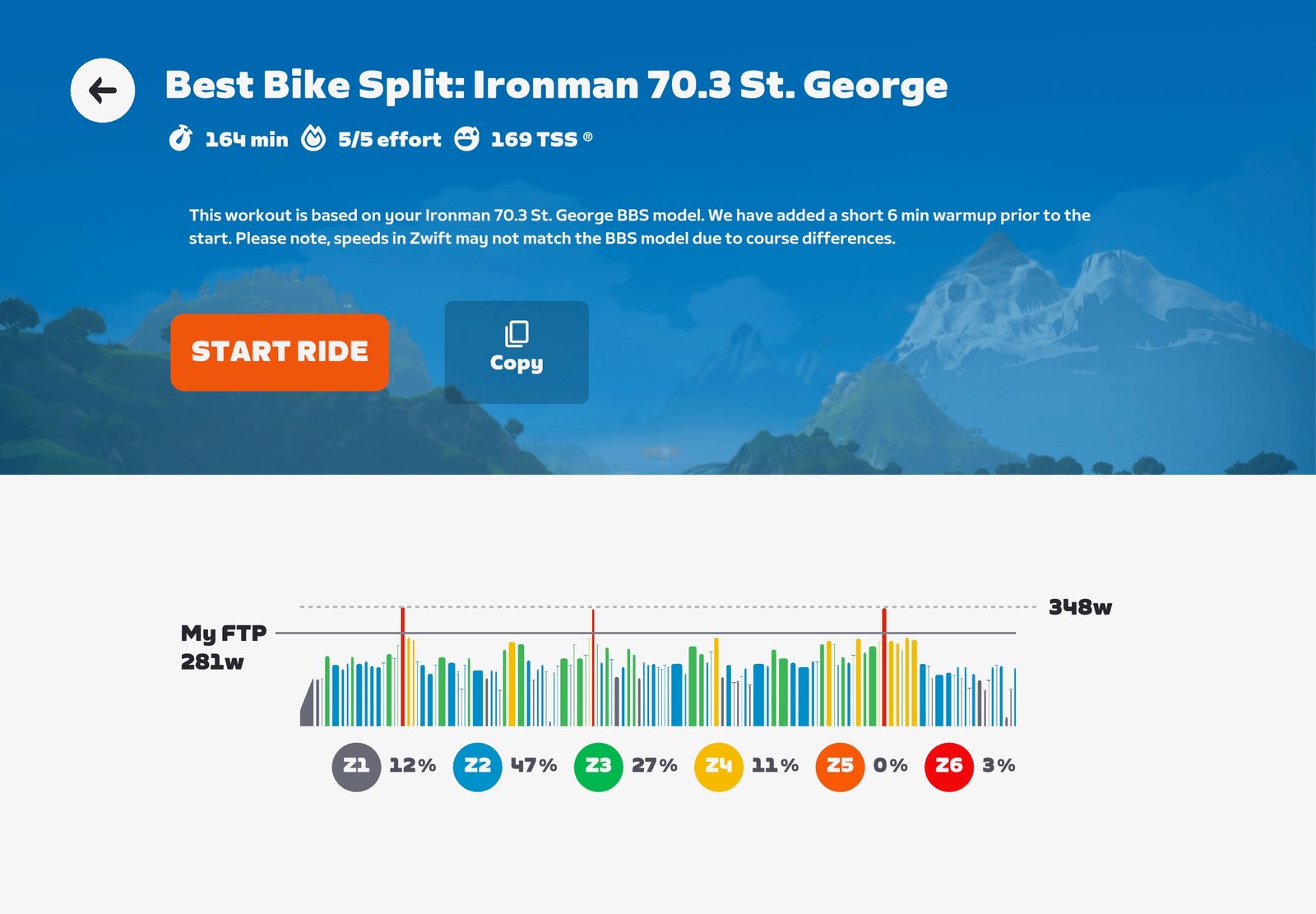
Best Bike Split now integrates directly with Zwift. I don’t think it was widely announced except on the Zwift forum, but cool nonetheless, since you can now send Best Bike Split race plans to Zwift as a workout so you can practice your pacing plan there. I’m still waiting for TrainerRoad to ship their own Zwift integration, but I think this fun St. George race simulation will keep me entertained in the meantime.
-
Next year’s edition of Ironman 70.3 St. George will be the final one. St. George is by far my favorite race I’ve done since I started triathlons, so I’m sad to hear that the 2025 edition will be the last one for the foreseeable future. I’m signed up for it, but I was hoping to race there for many years to come.
-
Ironman 70.3 is coming back to Boise. Ironman just announced the return of Ironman 70.3 Boise, which ran from 2008 through 2015. This would be the closest race to me, and Boise is such a nice town, I’m very tempted to sign up for next year’s race—running along the Greenbelt is so pleasant.
I’ve been reading some race reports from back then, such as this one from DC Rainmaker in 2011, and it sounded like a tough race, starting with a swim in 11°C water. It might be tough in a different way next year, though: the high in Boise in late July is usually above 38°C and by then smoke season is in full swing. I’m still tempted.
-
CORE introduces a new heat adaptation score. I’ve had a CORE sensor for a while but my biggest complaint has been that it’s hard to understand and act on the data it shows, so for the most part it’s been sitting in a drawer. That said, I do like this new heat adaptation score the app now shows front and center. It’s nice to have all this data condensed down to an easily digestible metric, and, unlike the heat adaptation metric in Garmin Connect, I can use it to track my indoor heat training. Now let’s see if I can get it to 100% before Ironman Canada.
-
This year’s Ironman Canada will be the last in Penticton. Not entirely surprising; I thought the writing was on the wall when they unveiled another Ironman Canada in Ottawa, but they just made it official today. This is a huge bummer for me personally; I don’t think there are any other full-distance races that are within a reasonable driving distance, and I don’t want the hassle of flying with my bike and gear. This puts a lot more pressure on me to finish this year’s race—I might not have another shot at a full Ironman anytime soon. It’s do or die.